





Article Contents
What Is Serialization in the Pharmaceutical Industry?
Serialization assigns a unique identifier, typically a 2D Data Matrix code, to every saleable unit that leaves a pharmaceutical facility. That code is captured and verified at multiple points as the product moves through the line: at the bottle level, the carton level, the case level, and often the pallet level. Each of those capture points depends on the product arriving at the right spot, in the right position, at a speed the vision system and labeler can actually work with.
This is the core of the serialization of pharmaceutical products: a chain of scans that has to hold together from the first unit off the filler to the last pallet loaded onto a truck. Miss one link and the whole chain becomes unreliable, which is exactly what regulators are trying to prevent.
Why Pharmaceutical Serialization Regulations Are Necessary
In the United States, the Drug Supply Chain Security Act (DSCSA) requires manufacturers to serialize and trace prescription drugs through the supply chain. In Europe, the EU Falsified Medicines Directive (EU FMD) sets a parallel requirement. Both exist to make counterfeit and diverted drugs traceable and to give every party in the supply chain, from manufacturer to pharmacy, a way to verify that a product is what it claims to be.
Span Tech is not a compliance authority, and delving into the finer points of DSCSA or EU FMD reporting requirements is best left to a regulatory or software partner. What pharmaceutical serialization regulations mean for a production floor is more concrete: the equipment on the line has to physically support serialization, not just the software behind it. That is where conveyor design becomes part of the compliance picture instead of an afterthought.
The Conveyor's Role in Serialization Track and Trace
Vision systems and print-and-apply labelers are precise instruments, but they are only as good as what the conveyor delivers to them. A successful serialization track and trace program depends on:
- Consistent product spacing, so the vision system reads one code per cycle instead of missing units or double-reading gaps.
- Stable orientation, so the code faces the camera the same way every time.
- Controlled, predictable speed, since many pharmaceutical lines run serialization stations at rates that exceed 300 units per minute.
- Minimal vibration, particularly at the exact point where the code is printed, applied, or scanned.
None of that is a labeler problem. It is a conveyor design problem, and it is where a line either supports pharmaceutical serialization compliance or quietly works against it.
Conveyor Capabilities That Enable Compliant Pharmaceutical Serialization
A few specific conveyor capabilities are what actually make serialization work reliably on the floor:
- Precise accumulation. Accumulation conveyors feed labelers at a uniform pitch, so units arrive at the print-and-apply station correctly spaced rather than bunched together or spread too far apart. Without controlled accumulation, a labeler either waits on gaps or gets flooded, and both outcomes produce bad reads.
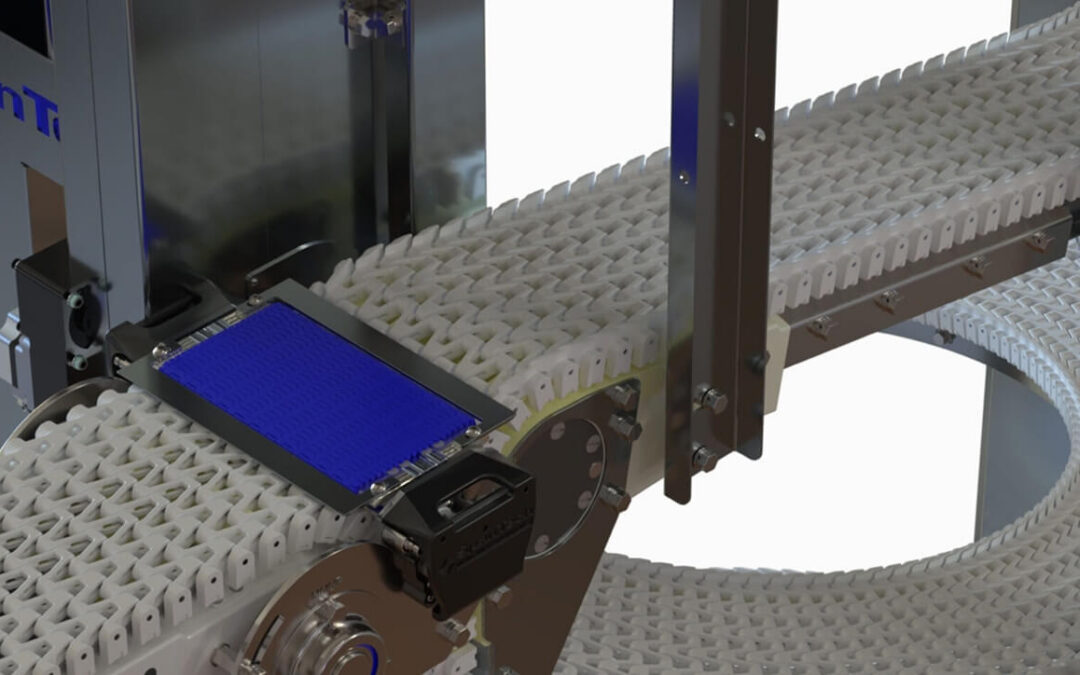
- Low-vibration transfers. Microspan transfers are built to bridge small gaps between conveyor sections without jostling the product, which matters most directly between vision read points. A vial or bottle that shifts even slightly during a transfer can produce a misaligned code that fails verification for no reason related to the code itself.
- Reject conveyors that isolate failures. When a unit fails a serialization read, it has to come off the line without touching or contaminating units that passed. A powered divert conveyor pulls failed units aside quickly and cleanly, keeping the main flow moving and keeping rejected product separated for review.
- Tight orientation control for small units. Vials, small bottles, and blister packs need a chain that holds them steady without excess play. The 25mm SuperTight chain was built for tight-radius handling and gives small pharmaceutical containers the orientation control that serialization scanning depends on.
- Room for other inline checkpoints. Serialization rarely runs alone. Many pharmaceutical lines also route product through metal detector-ready conveyor sections for contamination screening at the same stage. A conveyor built for serialization has to accommodate those additional checkpoints without disrupting the spacing and speed the vision system needs downstream.
Aggregation and Serialization in Pharmaceutical Packaging
A cooling tunnel conveyor encloses the belt inside a housing so airflow, and in some cases refrigeration, can be directed and controlled around the product rather than dissipating into the open plant environment. This gives the tightest control over cooling conditions of the three configurations, since ambient plant temperature and humidity no longer dictate how fast the product cools.
Cooling tunnel conveyors are typically specified when a product requires a controlled cooling environment, whether that means forced ambient air, chilled air, or a specific humidity level to prevent condensation or case hardening. Meat, dairy, and confectionery lines often lean toward a tunnel configuration for this reason, since product consistency depends on tighter environmental control than open-air cooling can provide.
Building a Line for Pharmaceutical Serialization and Traceability
Pharmaceutical serialization and traceability requirements are not going away, and for most manufacturers, they are only getting more detailed as international markets add their own versions of DSCSA and EU FMD. A pharmaceutical serialization track-and-trace program built on a conveyor not designed with these requirements in mind will continue to produce avoidable rejects, no matter how good the vision system or software is.
Span Tech designs conveyor systems around exactly these requirements, from accumulation and transfers to chain selection and reject handling, so that pharmaceutical serialization compliance is built into the physical line rather than patched around it after the fact. For a broader look at the equipment features that matter across pharmaceutical production, see our guide to top pharmaceutical conveyor features.
Get a Serialization-Ready Pharmaceutical Conveyor System from Span Tech
A serialization program is only as reliable as the line running underneath it. If your facility is adding serialization, expanding into aggregation, or troubleshooting rejects on an existing line, the conveyor layout is the place to start, not the last thing to check. Span Tech works with pharmaceutical manufacturers to design accumulation, transfer, and reject conveyor systems built around the spacing, orientation, and speed that serialization and aggregation actually require.
Contact our team to talk through your current line, your serialization requirements, and where a custom conveyor solution can close the gap between what your vision system needs and what your conveyor is currently delivering.
Frequently Asked Questions
What's the difference between serialization and aggregation?
Serialization assigns and verifies a unique code on an individual saleable unit, such as a single bottle or carton. Aggregation goes a step further by linking those individual codes together in a parent-child relationship, connecting each bottle to its carton, each carton to its case, and so on, so the entire packaging hierarchy can be traced from a single scan.
At what line speeds can serialization realistically operate?
Many pharmaceutical serialization stations are designed to run at rates exceeding 300 units per minute, but the real ceiling depends on the conveyor feeding the vision system. A line with precise accumulation, stable transfers, and low vibration can sustain higher, more consistent speeds, while a line with inconsistent spacing or product handling will force the station to slow down or generate rejects to compensate.
How does serialization affect line layout and floor space?
Serialization and aggregation add checkpoints, not just equipment. Each scanning point (bottle, carton, case, and sometimes pallet) needs enough dedicated conveyor length to maintain proper spacing and orientation before and after the read. Facilities retrofitting serialization into an existing line often need to reconfigure accumulation and transfer sections to create that space rather than simply bolting a labeler onto the existing layout.